
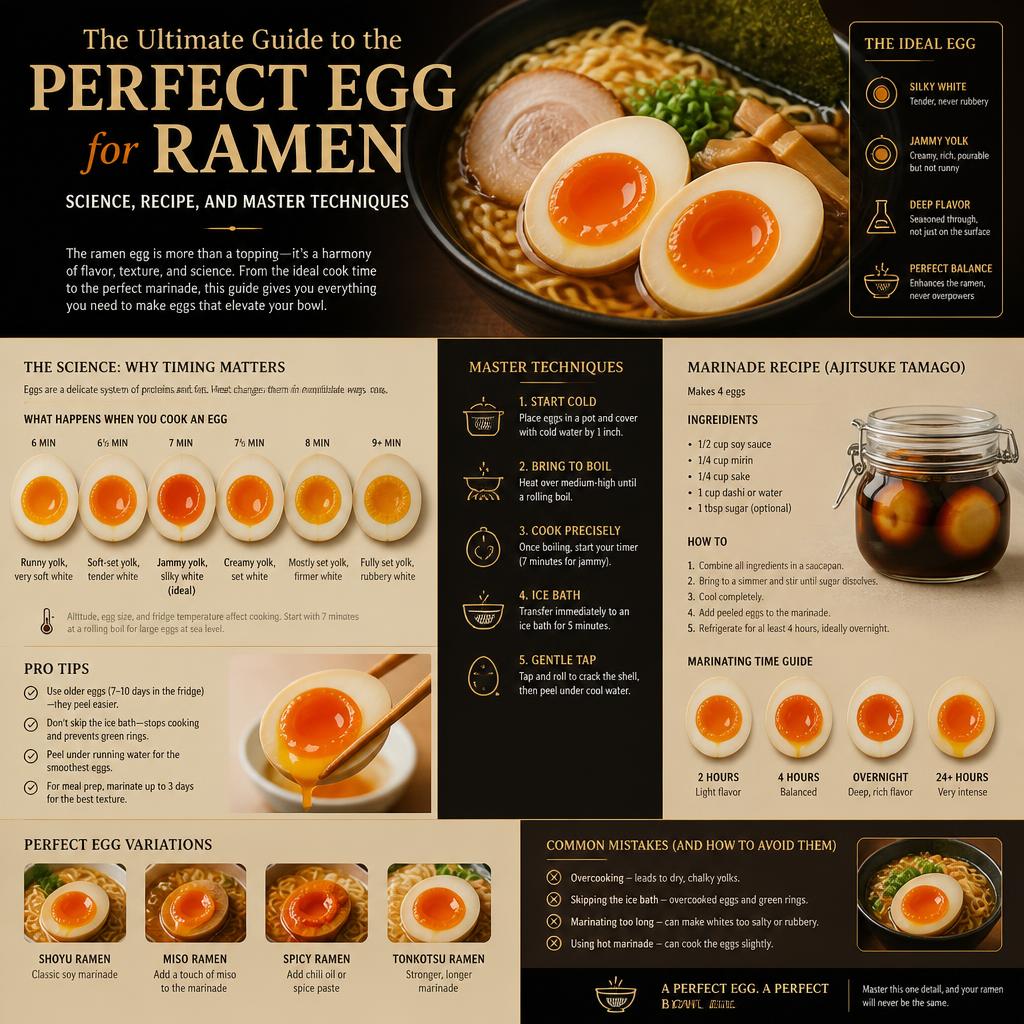
If you have ever sat down in front of a steaming bowl of authentic Japanese noodles, you know that the crowning jewel isn’t just the rich broth or the tender chashu pork. It is the egg. The perfect egg for ramen—known in Japan as Ajitsuke Tamago (or Ajitama for short)—is a culinary marvel. It features a firm, savory white and a jammy, custard-like golden yolk that melts into the broth, elevating the entire dining experience.
But how do top-tier ramen shops achieve that flawless texture and deep, umami flavor profile? Making the ultimate egg for ramen is part science, part art, and entirely achievable at home.
In this comprehensive guide, we will break down the history, the food science, a foolproof recipe, and advanced troubleshooting tips to help you master the art of the ramen egg.
1. What Makes a Ramen Egg So Special?
Unlike a standard hard-boiled egg or a standard Western soft-boiled egg, a traditional egg for ramen undergoes a specific transformation. It is soft-boiled to exact specifications, immediately shocked in ice water to halt cooking, and then marinated in a savory bath of soy sauce, mirin, sake, and aromatics.
Through the process of equilibrium, the marinade cures the egg. The salt pulls moisture out of the yolk, concentrating its flavors and turning the texture from runny to a thick, spreadable, jammy custard.
Quick Anatomy of the Perfect Ajitama:
-
The Exterior: A uniform, light-brown stain from the marinade without being rubbery.
-
The Egg White: Fully set, tender, and seasoned throughout.
-
The Yolk: Custard-like, viscous, and deeply golden—never dry, powdery, or completely liquid.
2. The Science of Boiling the Perfect Egg for Ramen
To get the perfect texture, you have to understand protein coagulation. Egg whites and egg yolks cook at entirely different temperatures:
-
Egg Whites (Ovalbumin): Begin to solidify around 60°C to 65°C (140°F–149°F).
-
Egg Yolks (Vitellin): Begin to thicken at 65°C (149°F) but don’t fully set until 70°C (158°F).
Our goal when making an egg for ramen is to keep the internal temperature of the yolk right around 63°C to 65°C while pushing the whites past 68°C. This requires precision timing down to the second.
Large vs. Extra Large Eggs
Always use Large eggs straight from the refrigerator. If you use Extra Large or Medium eggs, the cooking times below will vary by 30 to 45 seconds, which can ruin the jammy core.
3. The Foolproof Ramen Egg Timeline
Here is a breakdown of how boiling times affect a Large egg dropped directly into boiling water:
[6:00 Mins] ─── Liquid Yolk, Soft Whites (Hard to peel)
[6:30 Mins] ─── THE SWEET SPOT: Perfectly Jammy Yolk, Set Whites
[7:00 Mins] ─── Custard Yolk, Firm Whites
[8:00 Mins] ─── Medium-Hard Yolk (Too dry for authentic ramen)
For the definitive egg for ramen, 6 minutes and 30 seconds is the golden standard.
4. Master Recipe: Authentic Ajitsuke Tamago
This recipe yields 6 perfectly marinated ramen eggs.
Ingredients
For the Eggs:
-
6 Large eggs (cold, straight from the fridge)
-
2 tbsp Vinegar (helps make peeling easier)
-
1 large bowl of ice water
For the Umami Marinade:
-
½ cup Water
-
½ cup Soy sauce (preferably Japanese Shoyu)
-
¼ cup Mirin (Japanese sweet rice wine)
-
2 tbsp Sake
-
1 tsp Sugar
-
1 clove Garlic, crushed (optional)
-
1 slice Fresh ginger (optional)
Step-by-Step Instructions
Step 1: Prepare the Marinade
In a small saucepan, combine the water, soy sauce, mirin, sake, sugar, garlic, and ginger. Bring the mixture to a gentle simmer over medium heat just until the sugar dissolves and the alcohol scent from the sake dissipates (about 1–2 minutes). Remove from heat and let it cool completely to room temperature.
Critical Note: Never put boiled eggs into a warm marinade, or they will continue to cook, ruining the jammy yolk!
Step 2: Boil the Eggs
Bring a large pot of water to a rolling boil. Ensure there is enough water to completely submerge the eggs. Add the vinegar.
Using a slotted spoon, gently lower the cold eggs into the boiling water one by one. Immediately turn the heat down slightly to a medium-high simmer; you want bubbles, but not a violent boil that will crack the shells.
Step 3: Stir and Time
For the first 2 minutes, gently stir the eggs in a circular motion. This forces the yolk to stay perfectly centered within the egg white, creating a beautiful aesthetic when sliced. Set a timer for 6 minutes and 30 seconds.
Step 4: The Ice Bath Shock
As soon as the timer goes off, transfer the eggs immediately into the ice water bath using your slotted spoon. Leave them in the ice bath for at least 10 minutes. This stops the cooking process instantly and causes the egg to shrink slightly inside the shell, making it infinitely easier to peel.
Step 5: Peel with Care
Gently tap the bottom of the egg (where the air pocket is) on a hard surface, then roll it gently to crack the shell all over. Peel the eggs either submerged in your ice bath or under a gentle stream of cold running water.
Step 6: The Marination Process
Place the peeled eggs into a ziplock bag or a narrow container. Pour the cooled marinade over them.
To ensure the tops of the eggs don’t float up and remain un-marinated, place a folded piece of paper towel directly on top of the liquid. The paper towel absorbs the marinade and drapes over the eggs, ensuring 360-degree color and flavor.
Seal and refrigerate for at least 4 hours, ideally 12 to 24 hours.
5. How to Store and Serve Your Ramen Egg
Longevity
Ramen eggs are best consumed between 12 and 48 hours of marination. After 24 hours, it is highly recommended to remove the eggs from the liquid marinade. If left in the liquid for multiple days, the salt will continue to cure the yolk, turning it completely solid, rubbery, and overly salty.
Once removed from the marinade, they can be stored in an airtight container for up to 4 days.
The Clean Cut Technique
Never cut a soft-boiled egg for ramen with a standard kitchen knife; the jammy yolk will stick to the blade and create a messy, jagged cut. Instead, use one of these two professional methods:
-
Fishing Line / Unflavored Dental Floss: Wrap a piece of clean line around the center of the egg, cross the ends, and pull firmly to slice cleanly through.
-
A Hot Knife: Dip a sharp knife into hot water, wipe it clean quickly, and slice through the egg in one smooth stroke. Clean the blade between cuts.
6. Pairing Your Egg with Different Ramen Broths
The seasoning of your egg should complement the soul of your soup. Here is how to adapt your master egg recipe for different styles of ramen:
| Ramen Style | Broth Profile | Egg Marinade Adjustment |
| Tonkotsu | Rich, creamy pork bone broth. | Stick to the Classic Recipe. The sweet mirin balances the heavy, savory fats of the pork. |
| Shoyu / Shio | Light, soy or salt-based clear broth. | Infuse the marinade with extra ginger and dashi powder to match the delicate, clean seafood notes. |
| Miso / Spicy | Thick, earthy, and fiery paste broth. | Add a dash of chili oil (Rayu) or Gochugaru to the marinade to give the egg a subtle heat kick. |
7. Troubleshooting Common Ramen Egg Mistakes
Even seasoned chefs occasionally slip up with their Ajitama. Here is how to fix common issues:
“The shells are impossible to peel and tearing the whites!”
-
The Cause: Your eggs were too fresh. Fresh eggs have a lower pH, which causes the egg white proteins to stick tightly to the inner shell membrane.
-
The Fix: Buy your eggs a week before you plan to boil them. Also, never skip the ice bath, and try peeling them underwater.
“The yolk is completely cooked and powdery.”
-
The Cause: Either your boiling time was too long, your water boiled too aggressively, or you put the eggs into a warm marinade.
-
The Fix: Use a digital timer, adjust to exactly 6:30, and ensure your marinade is completely cold before dropping the eggs in.
“The egg is unevenly colored.”
-
The Cause: The eggs floated to the top of the marinade container and exposed their tops to the air.
-
The Fix: Use the paper towel trick mentioned in Step 6 to keep them completely submerged.
Conclusion: Elevate Your Home Cooking
Perfecting the egg for ramen is a rite of passage for any home chef or noodle enthusiast. It bridges the gap between a simple home-cooked meal and a luxury restaurant experience. By understanding the timing, mastering the ice shock, and allowing the umami marinade time to work its magic, you will create a luxurious, custard-filled topping that makes every bowl of ramen unforgettable.
Fire up your stove, grab your timer, and enjoy the process of making the perfect jammy egg!